
AVT-UC01 — Joint Terrestrial and Satellite In-Flight Connectivity
Goals
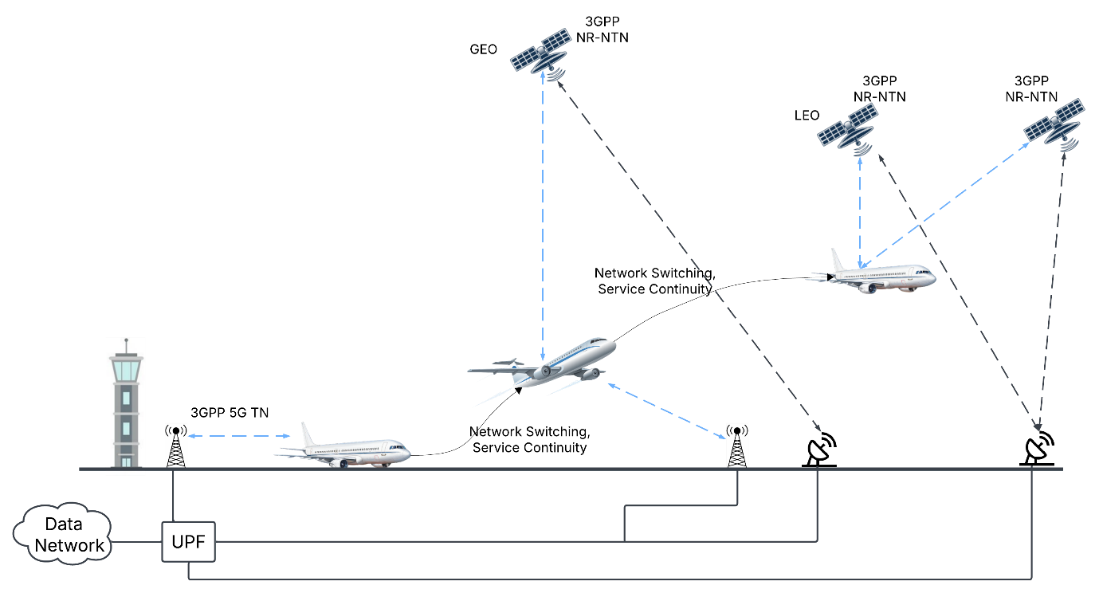
- Deliver Internet connectivity for passengers with legacy devices (WiFi/3GPP interfaces) across all flight phases.
- Achieve seamless handovers across TN and NTN links for uninterrupted user experience.
High Level Description
Passengers access the Internet throughout the flight via two main paths:
- Direct Access to the TN:
- • Utilizes available terrestrial base stations during flight phases (takeoff, landing, low-altitude cruise) where coverage exists.
- Access via the Plane Customer-Premises Equipment (CPE):
- • The plane’s CPE connects to a data network through either terrestrial or satellite (NTN) links.
- • The CPE creates an in-cabin Radio Access Network (RAN) using WiFi or 3GPP-based solutions, allowing passengers to connect using legacy devices.
In either of the two cases the Passenger Device accesses the internet through a legacy interface (WiFi or 3GPP) and experiences service continuity whenever a link handover is performed (e.g., TN-NTN, NTN-NTN)
AVT-UC02 — Integration of 3GPP and non-3GPP Technologies for access to offboard connectivity
Goal
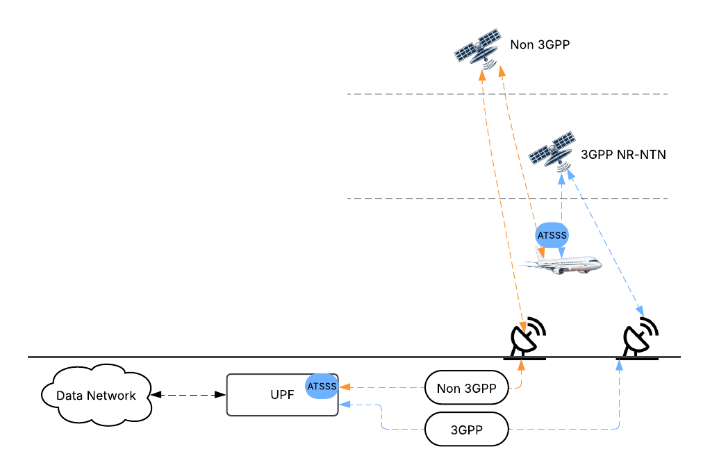
- Achieve robust plane connectivity throughout all flight phases (including areas where NTN is unavailable).
High Level Description
The plane maintains continuous connectivity from gate-to-gate by using:
- 3GPP Links:
- • TN and NTN (satellite-based) 5G-NR connections.
- • Active during phases of flight when 3GPP coverage is available (e.g., near airports for TN, at altitude for NTN).
- Non-3GPP Links:
- • Examples include DVB-S2/S2X (satellite digital video broadcasting) and standard Satcom links.
- • Used as fallback or complementary links when 3GPP NR is unavailable or to supplement 3GPP links for throughput/robustness.
The plane CPE dynamically manages these links and ensures continuous connection to the Core Network, even if 3GPP connectivity is not available.
AVT-UC03 — Joint connectivity for User Access to In-Flight Entertainment
Goals
- Maximize aggregated throughput for in-flight entertainment services.
- Maintain uninterrupted content delivery regardless of user movement or link obstruction.
High Level Description
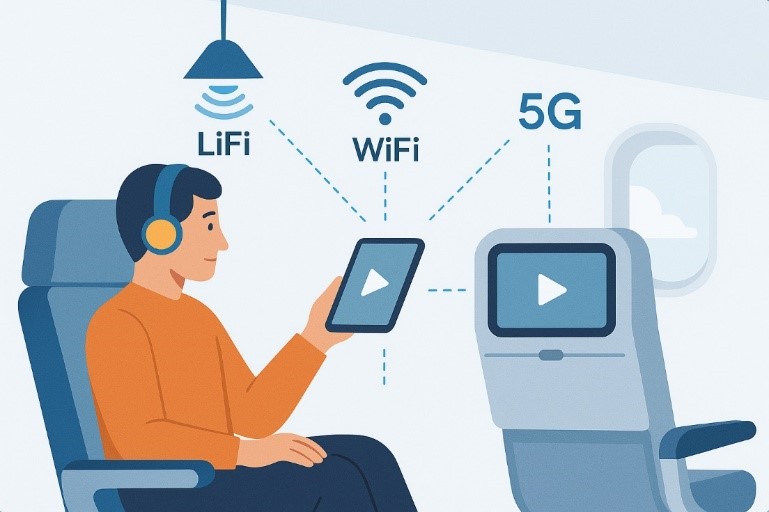
Passenger receives content available on the plane (e.g. video/movies) from multiple sources (multilink/multi carrier aggregation) with 3GPP and non-3GPP carriers (WiFi/LiFi), via passenger-owned and/or dedicated (e.g. in-seat screen) devices. LiFi provides a high-speed channel when unobstructed, while WiFi and 5G (5G private network) serve as alternative or complementary links. The system dynamically switches between or aggregates multiple links to optimize content delivery.
Passengers access in-flight entertainment (IFE) content from onboard sources through a combination of multiple access technologies:
- LiFi:
- • Provides high-speed optical wireless communication.
- • Used when the optical line-of-sight is clear.
- WiFi and 5G (Private Network):
- • Serve as complementary or backup links when LiFi is obstructed or for non-line-of-sight areas.
- • Provide additional coverage and capacity.
- Multi-Link/Multi-Carrier Aggregation:
- • The system aggregates or dynamically switches between LiFi, WiFi, and 5G links.
- • Optimizes throughput and adapts to real-time link conditions (e.g., user movement, device type, link congestion).
AVT-UC04 — Joint Connectivity for Gate Data Transfer
Goal
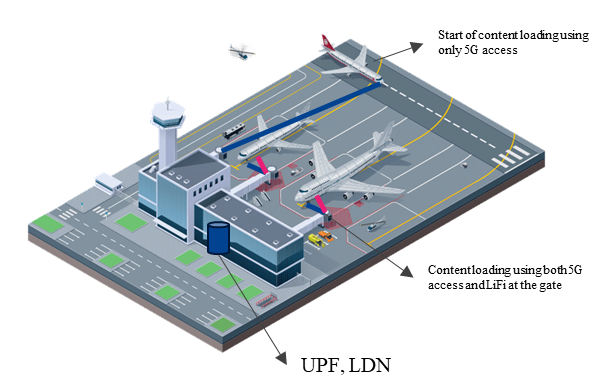
- Reduce content load time at the gate by maximising available bandwidth and ensuring high link uptime using best available link(s) at the airport.
High Level Description
New content/SW updates are automatically loaded to the aircraft at the airport using multi-link with 3GPP (5G-NR) and non-3GPP carriers (e.g. WiFi/LiFi). Data logs are automatically downloaded at the airport in the same way.
LiFi, with its high-speed, enables rapid content loading and enhances overall data transfer performance, while complementing WiFi and 5G. Similarly, data logs are automatically downloaded using the same multi-link strategy.
AVT-UC05 — Resource Optimisation for In-Cabin Access Networks
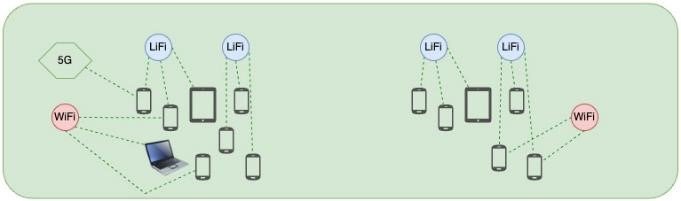
Goal
- Minimize the power consumption of in-cabin communication networks while maintaining reliable, high-speed connectivity. Reduce overall energy usage while ensuring seamless passenger connectivity and network stability.
High Level Description
In-cabin aircraft communication networks require optimized energy efficiency to ensure sustainable, high-performance connectivity while minimising power consumption. Various wireless technologies, including LiFi, WiFi, and 5G, contribute to in-flight connectivity, and optimising their power usage is essential for long-term operational efficiency.
To achieve this, strategies focus on reducing the power consumption of transceivers, refining network architectures, and, if feasible, exploring alternative hardware implementations to improve overall energy efficiency.

