
RLW-UC01 — Joint Terrestrial and Satellite On-Board Connectivity
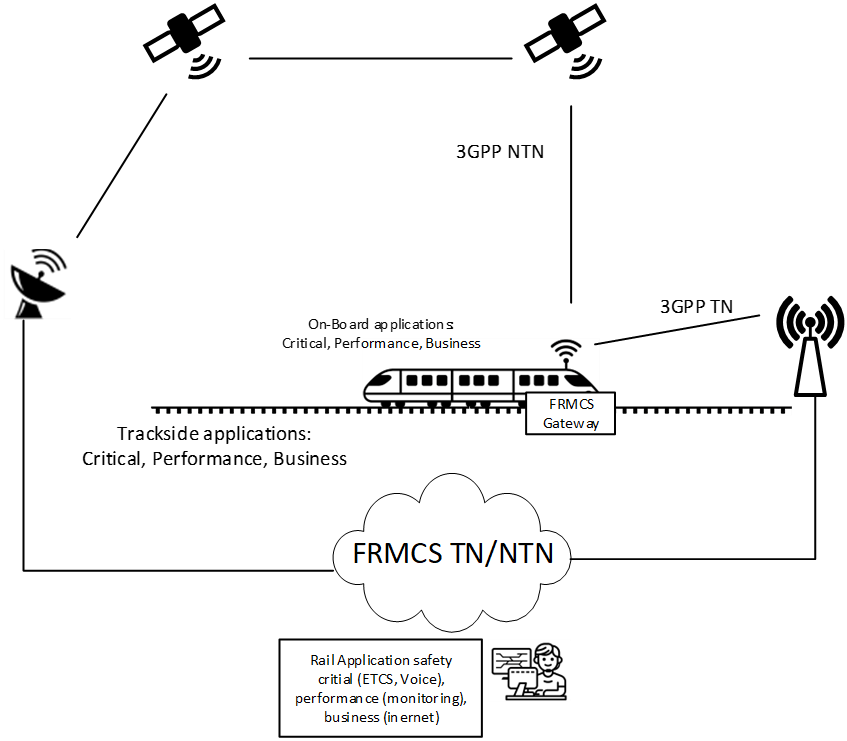
Goal
- To support performance and business communications, ensuring high-quality connectivity for crew, maintenance, logistics, and passenger services. (Actors: Passengers, Train Crew, Railway Control.)
High Level Description
Seamless, uninterrupted, high-quality communication for trains by dynamically switching between or simultaneously using TN and NTN networks. This ensures that train operations and services function without disruption, regardless of location, speed, or constraints such as tunnels, rural areas, or degraded modes. The hybrid network serves critical, performance, and business communications, ensuring a resilient, multi-connectivity network for reliable train operations.
A key focus is providing uninterrupted connectivity for all railway services, including mission-critical operations, performance applications, and business communications, ensuring ultra-reliable, low-latency connectivity even in high-speed or remote/rural areas.
RLW-UC02 — Optimized Mobility Management and Resource Orchestration for High-speed Trains
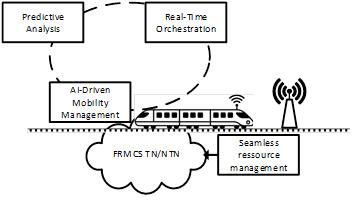
Goal
- Utilizing 6G TN/NTN AI-driven mobility management to dynamically optimize network resources, ensuring seamless connectivity for high-speed trains. The system leverages predictive analytics and real-time orchestration to anticipate demand variations and pre-allocate resources accordingly, reducing network congestion and improving service quality.
High Level Description
Using 6G TN/NTN intelligent mobility management to dynamically optimize network resources, ensuring seamless connectivity for high-speed trains. The system leverages predictive analytics and real-time orchestration to anticipate demand variations and pre-allocate resources accordingly, reducing network congestion and improving service quality.
RLW-UC03 — Ubiquitous IoT Integration for Railway Monitoring
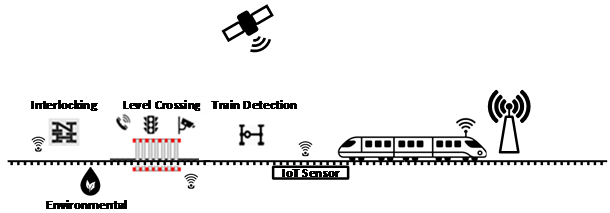
Goal
- Enable continuous real-time monitoring of railway infrastructure, including track conditions, environmental factors, and train/couch. And to ensure seamless TN/NTN IoT connectivity for un-interrupted data transmission in challenging railway environments.
High Level Description
Leveraging 6G TN/NTN-enabled IoT to deploy long-life, energy-efficient sensors for real-time railway infrastructure monitoring. By integrating advanced power-saving mechanisms and energy harvesting solutions, IoT devices can operate autonomously for years while ensuring seamless TN/NTN connectivity
RLW-UC04 — Joint Connectivity for User Access to On-board Entertainment
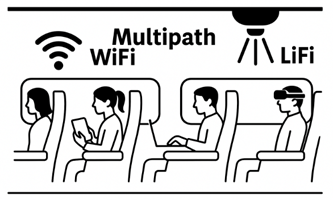
Goal
- Increase the overall user throughput and ensure uninterrupted content delivery by dynamically utilising one or multiple links based on real-time network conditions, providing optimal performance. Provide new options/flexibility of using alternative frequency bands and wavelengths for various user sub-groups and situations.
High Level Description
Passenger receives content available on the train (e.g. video/movies) from multiple sources (multilink/multi carrier aggregation) with WiFi and LiFi, via enhanced future passenger-owned devices. LiFi provides a high-speed channel when unobstructed, while WiFi serves as alternative or complementary link. The system dynamically switches between or aggregates multiple links (e.g., using multipath TCP) to optimize content delivery.

